
Barcelona's Most Famous Market: The Complete La Boqueria Guide

Barcelona stops you in your tracks. The smells hit first — jamón, fresh fruit, grilled seafood. You follow your nose down La Rambla, and there it is: La Boqueria. But is it still worth visiting in 2025? And what else does Barcelona's market scene offer? This guide answers every question.
What Is La Boqueria? The Barcelona Famous Market Explained
La Boqueria — officially Mercat de Sant Josep de la Boqueria — is the most famous market in Barcelona. It sits on La Rambla, in the Ciutat Vella district, right in the heart of the city.
Quick definition: The word boqueria comes from the old Catalan word boc, meaning "goat." The original market sold goats and livestock outside the city walls. Today, it sells everything from tropical fruit to fresh seafood, Catalan meat, dairy, tapas, and candy.
In English, mercat simply means "market." La Boqueria is Barcelona's market — the one locals and visitors have known for nearly two centuries.
What is La Boqueria in 40–60 words? La Boqueria is an indoor food market in Barcelona, Spain, located on La Rambla in the Ciutat Vella neighbourhood. Founded in the 19th century, it covers over 2,500 square meters and houses more than 200 stalls selling fresh produce, meat, fish, seafood, dairy, spices, tapas, and Catalan specialties.
La Boqueria Barcelona History: From Goats to Global Icon
The Origins: Before the Current Building
The history of La Boqueria goes back further than most visitors realise.
An open-air market existed on this site as early as 1217, when traders gathered outside the old city gates. By the 13th century, stalls selling meat, vegetables, and eggs were a permanent fixture near the old Sant Josep convent on La Rambla.
The Napoleonic Wars changed everything. In 1835, the convent was demolished during anti-clerical riots. The empty space was officially designated as a public market space. The la boqueria barcelona year established as a formal institution is generally cited as 1836, when the city of Barcelona officially authorised the marketplace on the convent site.
The Current Building: 1882
The current building — the iconic metal structure with its triangular entrance gate — dates from 1882. The architect behind it was Antoni Rovira i Trias, one of Barcelona's most respected 19th-century designers. He is also known for his work across the Eixample district, the planned expansion of the city.
The iron roof and skeletal framework reflect the industrial architecture of the period — similar in spirit to Les Halles in Paris or the great covered markets of Victorian London.
The market opened in its current form in 1882, though it was expanded and renovated several times throughout the early 20th century. By 1913, the market had taken on much of the layout visitors see today.
La Boqueria market Barcelona history timeline:
Year | Event |
1217 | First recorded market activity near the site |
1836 | Official designation as a public market |
1848 | Iron structure construction begins |
1882 | Current building completed (Antoni Rovira i Trias) |
1913 | Major expansion and current layout established |
2001 | Recognised as one of Europe's top food markets |
2005 | Tourist pressure leads to vendor regulation debates |
2017 | Barcelona City Council introduces vendor restrictions |
Inside La Boqueria: What You'll Find at Each Stall
La Boqueria covers over 2,500 square meters. More than 200 vendors operate inside.
What's inside:
Fresh fruit stalls — Tropical fruits, local Catalan produce, freshly cut fruit cups
Seafood and fish — Live shellfish, fresh Mediterranean fish, boquerones (anchovies), prawns
Meat and charcuterie — Jamón ibérico, Catalan sausages (botifarra), cured meats
Vegetables — Local farms supply seasonal produce daily
Dairy — Catalan cheeses, yoghurts, fresh cream
Tapas bars — Counter seating, fresh pintxos, grilled seafood
Candy and sweets — Colourful sugar displays, chocolate, nougat
Spices and dried goods — Saffron, paprika, herbs, dried legumes
Flowers — Cut flowers and plants, near the entrance on La Rambla
The stalls at the front, closest to La Rambla, tend to be the most tourist-focused — brightly displayed fruit cups at high prices. The further you walk inside, the more authentic the experience becomes. Locals shop at the back stalls.
🟨 Pro Tip Skip the pre-cut fruit cups near the entrance. They cost 3–5x more than preparing your own. Walk to the back third of the market for better prices and fewer crowds.
La Boqueria Market Barcelona Hours: When to Visit
Official opening hours:
Day | Hours |
Monday | 8:00 AM – 8:30 PM |
Tuesday | 8:00 AM – 8:30 PM |
Wednesday | 8:00 AM – 8:30 PM |
Thursday | 8:00 AM – 8:30 PM |
Friday | 8:00 AM – 8:30 PM |
Saturday | 8:00 AM – 8:30 PM |
Sunday | Closed |
La Boqueria is closed on Sundays and on certain public holidays. Individual vendor hours vary — some tapas bars open at 6:00 AM, while some fresh produce stalls close by early afternoon.
Best time to visit:
7:30–9:00 AM — Arrive before it opens or right at opening. Locals shop here. Crowds are thin.
9:00–11:00 AM — Still manageable, especially on weekdays.
12:00–3:00 PM — Peak tourist hours. Expect tight corridors and long waits at tapas bars.
Late afternoon (4:00–6:00 PM) — Many stalls start closing or running low on stock.
🟦 Local Insight Tuesday and Wednesday mornings are the quietest weekdays. Avoid Saturdays between 10:00 AM and 2:00 PM — that's when tourist groups arrive in force.
How to Get to La Boqueria
La Boqueria sits at La Rambla 91, Barcelona. It's one of the most accessible locations in the city.
By Metro:
Liceu station (L3 – Green Line) — 2-minute walk. This is the closest stop.
Catalunya station (L1, L3) — 10-minute walk down La Rambla.
Drassanes station (L3) — 10-minute walk in the opposite direction.
The Barcelona–Vallès Line (FGC) stops at Plaça de Catalunya, a short walk away.
By Bus: Multiple bus lines run along La Rambla and the surrounding streets of Raval and Barri Gòtic.
By Car: Driving to La Boqueria is not recommended. Parking in Ciutat Vella is scarce and expensive. Use public transport or walk from your accommodation if you're staying centrally.
On foot: If you're staying in the Gothic Quarter (Barri Gòtic), La Ribera, or Raval, you're within 10–15 minutes on foot.
Is La Boqueria Worth Visiting? The Tourist Trap Question
This is the most honest question to ask before you go.
The reality: La Boqueria has become heavily tourist-oriented. Prices at many stalls — especially the fruit and tapas counters near the entrance — are significantly higher than elsewhere in the city. Some vendors refuse to sell single items to people who ask too many questions. The crowds between 10:00 AM and 3:00 PM make it difficult to move, let alone eat.
Barcelona City Council acknowledged this in 2017 and introduced measures to prioritise local vendors and reduce tourist-facing stalls.
But it's still worth visiting — if you go smart.
Go early (before 9:00 AM)
Focus on the back half of the market
Eat at the tapas counters, not the pre-packaged stalls
Buy cheese, jamón, or charcuterie to take away — the quality is excellent
Talk to vendors. The ones who've been there for decades are the heart of the place
The market has legitimate E-E-A-T behind its reputation. It is a working food market that has supplied Barcelona kitchens for nearly 200 years. It's also a UNESCO-adjacent cultural asset in a city that takes food seriously.
The Best Markets in Barcelona: Beyond La Boqueria
La Boqueria is the most famous, but Barcelona's market culture goes far deeper. The city has over 40 municipal markets (mercats municipals), each with its own character and neighbourhood identity.
Mercat de Sant Antoni
Located in the Sant Antoni neighbourhood, on the edge of Eixample, Mercat de Sant Antoni is arguably the best all-round market in Barcelona right now.
The building — a 19th-century iron structure — reopened after a decade-long renovation in 2009 and again after further works in 2019. It operates as a food market on weekdays and a book and coin market on Sunday mornings, drawing thousands of locals.
Designed in part using plans inspired by Antoni Rovira i Trias, the market represents a quieter, more authentic alternative to La Boqueria. The Eixample neighbourhood around it is full of cafés, wine bars, and local life.
Mercat de Santa Caterina
In the La Ribera neighbourhood, Mercat de Santa Caterina is one of the most architecturally striking markets in Europe. Its mosaic-tiled roof — designed by Enric Miralles and Benedetta Tagliabue (EMBT Architects) — is a landmark of contemporary Catalan architecture.
The market dates from the 19th century but was completely rebuilt between 1997 and 2005. During excavation, archaeological remains from the former Santa Caterina convent (medieval period) were discovered beneath the foundations. These are now preserved and visible inside the market.
The ceramic roof tiles — designed in spiralling colours to represent fruits and vegetables — are one of Barcelona's most photographed architectural details.
Mercat de Santa Caterina vs La Boqueria:
Feature | La Boqueria | Mercat de Santa Caterina |
Tourist crowds | Very high | Moderate |
Architecture | 1882 iron structure | Miralles/Tagliabue mosaic roof |
Price level | Higher (tourist stalls) | Lower, more local |
Location | La Rambla, Ciutat Vella | La Ribera |
Sunday hours | Closed | Partial |
Best for | First-time visitors | Local food shopping |
Mercat de la Concepció
In the Eixample district, on Passeig de Sant Joan, Mercat de la Concepció (also written Mercat de la Concepció) is best known for its flower stalls — open 24 hours. If you need flowers in Barcelona at 3:00 AM, this is where you go.
It's a working neighbourhood market, less visited by tourists, and a good place to shop for fresh produce, dairy, and seasonal vegetables.
Mercat del Born
Also in La Ribera, Mercat del Born no longer functions as a food market. It's a cultural centre and exhibition space. The 19th-century iron structure was repurposed after extraordinary archaeological discoveries during renovation — the remains of an entire 1714 neighbourhood destroyed during the War of Spanish Succession.
It's worth visiting as a historical and architectural site rather than a food market.
Mercat del Ninot
Located in Eixample, Mercat del Ninot is a local favourite. Less tourist traffic, good fresh produce, a trusted butcher and fishmonger section, and several excellent tapas counters. If you're cooking during your stay in Barcelona, this is where locals shop.
Barceloneta Market
Near the seafront neighbourhood of Barceloneta, this small market specialises in fresh fish and seafood. It serves the fishing community and local restaurants. Arrive early — the best catch sells fast.
Other Notable Markets
Mercat d'Horta — In the Horta-Guinardó district, far from tourist areas
Mercat de Gràcia — Serving the Gràcia neighbourhood
Mercat de Sarrià — In the quiet upper neighbourhood of Sarrià, near the hills
Fira de Bellcaire (Els Encants) — Barcelona's famous flea market near Glòries; open Monday, Wednesday, Friday, Saturday
Mercat de Sant Pere — One of the oldest market sites in the city
Barcelona indoor market vs open-air market:
Barcelona has both. La Boqueria, Santa Caterina, and Sant Antoni are all covered indoor markets. Els Encants (the flea market) is an open-air market under a striking modern mirrored roof. There are also seasonal outdoor markets — the Mercat de Sant Jordi book market on April 23rd is a beloved Catalan tradition.
Barcelona Market Culture: What Makes It Special
Barcelona's market culture is rooted in Catalan identity. These aren't supermarkets. They are social institutions.
The city's markets have historically been run by Barcelona City Council through a public body (Institut Municipal de Mercats de Barcelona). Each market belongs to its neighbourhood. Locals use them weekly — sometimes daily — for fresh fish, meat, cheese, and vegetables.
This matters for visitors because you're not just shopping. You're witnessing how the city feeds itself.
The relationship between Barcelona's markets and its food culture is direct. The tapas you eat at a restaurant in the Gothic Quarter likely started as ingredients at La Boqueria or Santa Caterina. The boquerones (anchovies) in a pintxos bar in La Ribera came through Barceloneta market. The Catalan cheeses you find at a wine bar in Gràcia passed through the Mercat de Gràcia.
If you want to understand Barcelona's food traditions more deeply, exploring local food and culinary culture in Barcelona gives you the full context behind what you see at the markets.
What to Eat at La Boqueria: A Food Guide
Best things to eat and buy at La Boqueria:
Jamón ibérico — Buy a wedge or have it sliced fresh at a charcuterie counter
Boquerones (anchovies) — Fresh or pickled; a Catalan staple
Seafood tapas — Grilled prawns, clams, razor clams at the market bars
Fresh juice — Worth paying for once; the tropical fruit combinations are excellent
Catalan sausages (botifarra) — Fresh black and white sausage from local farms
Artisan cheeses — Look for Garrotxa (a local goat's cheese) or Manchego
Pintxos — Bread-based snacks topped with cheese, cured meat, or seafood
Mango and pineapple — Cut fresh, sold by weight in the middle stalls (not the front)
🟩 Expert Tip The tapas bars inside La Boqueria — particularly those at the far end — are staffed by people who've worked the market for decades. Ask what's freshest that morning. They'll tell you. That's where you eat.
La Boqueria and Barcelona's Architectural Legacy
The market sits in a city defined by great architecture. La Boqueria's metal structure connects to a broader story.
Antoni Rovira i Trias — the architect of La Boqueria's current building — was the man who designed Barcelona's expansion into the Eixample grid. His 1859 plan for Eixample was overruled in favour of Ildefons Cerdà's, but Rovira's influence on 19th-century Barcelona is undeniable.
Antoni Gaudí worked during the same period. His buildings — Sagrada Família, Casa Batlló, Park Güell — define the Eixample and Gràcia neighbourhoods. Gaudí and the market are contemporaries. Both emerged from a period of intense architectural creativity in Catalonia known as Modernisme.
The Mercat de Santa Caterina (rebuilt 2005) by Enric Miralles and Benedetta Tagliabue sits in direct dialogue with this tradition — using ceramic tiles as Gaudí did, but in a 21st-century structural context.
Cooking With What You Buy: From Market to Kitchen
Buying at La Boqueria or any Barcelona market is only half the experience. The other half is cooking with it.
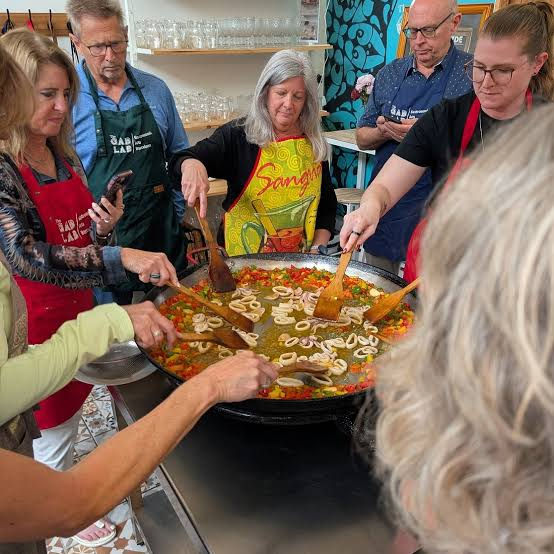
Barcelona has a growing culture of market-to-kitchen cooking classes that combine a market visit with hands-on cooking. You shop with a chef, then prepare a traditional Catalan meal.
If this interests you, Gastronomic Arts Barcelona offers cooking classes that pair market shopping with full cooking sessions — one of the best ways to connect the market experience with Catalan food traditions.
La Boqueria vs Other European Food Markets: A Comparison
Market | City | Founded | Covered | Best For |
La Boqueria | Barcelona | 1836 | Yes | Seafood, tapas, spectacle |
Mercat de Santa Caterina | Barcelona | 1845 (rebuilt 2005) | Yes | Local shopping, architecture |
Mercat de Sant Antoni | Barcelona | 1882 | Yes | Sunday books, neighbourhood feel |
La Boqueria equivalent: Mercado de San Miguel | Madrid | 1916 | Yes | Tapas, wine, tourists |
Borough Market | London | 1014 (modern era 1756) | Partial | Artisan food, crowds |
Mercato di Rialto | Venice | 900s | No (open-air) | Fish, produce |
Les Halles (historic) | Paris | Demolished 1971 | Was covered | Historic reference |
Prices at La Boqueria: What to Expect
Honest pricing guide (2025 approximate figures):
Item | Tourist stall (front) | Local stall (back) |
Pre-cut fruit cup | €5–8 | Not sold this way |
Fresh prawns (100g) | €4–6 | €2–4 |
Jamón ibérico (100g) | €8–15 | €6–10 |
Freshly squeezed juice | €3–5 | €2–4 |
Tapas plate at bar | €6–12 | €5–9 |
Artisan cheese (100g) | €3–6 | €2–4 |
Prices vary by vendor. The rule holds: the closer to La Rambla, the higher the price.
Must-Know Facts About La Boqueria
🟥 Must-Know Facts
La Boqueria's official name is Mercat de Sant Josep de la Boqueria
It has been operating in some form for over 800 years
The current building dates to 1882, designed by Antoni Rovira i Trias
It covers approximately 2,583 square meters
Over 200 vendors operate inside
It receives an estimated 45,000 visitors per day during peak season
The market is closed every Sunday
It sits at La Rambla 91, in the Raval side of Ciutat Vella
The word boqueria likely derives from the Catalan boc (goat)
Barcelona City Council restricted new tourist-facing licences in 2017
La Rambla: The Street That Connects Everything
You can't discuss La Boqueria without La Rambla. The market sits on this famous boulevard.
La Rambla runs 1.2 kilometres from Plaça de Catalunya down to the Columbus Monument at the waterfront. It passes through the Raval neighbourhood on one side and the Gothic Quarter on the other.
Why is La Rambla so famous? Because it has been Barcelona's social artery for centuries. It was where people walked, argued, sold goods, read newspapers, and celebrated. La Boqueria opened directly onto it because that's where the city moved.
Today, La Rambla is heavily tourist-focused — souvenir shops, overpriced cafés, and tourist menus dominate. But La Boqueria remains its most authentic feature.
The Liceu, Barcelona's opera house, sits two minutes from La Boqueria on the same street. The Barri Gòtic (Gothic Quarter) is one block east. The Raval neighbourhood — historically working-class, now a mix of students, artists, and long-term residents — borders it on the west.
Barcelona Flea Markets and Vintage Markets
Not every market in Barcelona is about food.
Fira de Bellcaire (Els Encants) — near Plaça de les Glòries in Eixample — is the city's oldest and largest flea market. It's been running since the 14th century. The current location opened in 2013 under a spectacular mirrored canopy roof designed to reflect the market and surrounding city.
It opens Monday, Wednesday, Friday, and Saturday. You'll find second-hand furniture, vintage clothing, books, ceramics, electronics, and genuine antiques alongside junk. Prices are negotiable.
Mercat de Sant Antoni also runs a book and coin market every Sunday morning outside its iron walls — a Barcelona institution.
Barcelona vintage market scene:
Mercat de l'Abaceria — In Gràcia, vintage clothing and antiques
Palo Alto Market — Design and artisan market in Poblenou (first weekend of the month)
Mercat de Sarrià — Small, neighbourhood antique market
Sustainable Shopping at Barcelona Markets
Barcelona's municipal markets operate as part of the city's sustainability infrastructure. Buying at a local market rather than a supermarket chain:
Supports small local vendors
Reduces packaging waste
Connects you with seasonal, local produce from Catalan farms
Keeps money in the city's neighbourhood economies
The Institut Municipal de Mercats de Barcelona manages the city's 40+ markets with this in mind. Their mandate includes keeping markets accessible to local residents, not just tourists — something that tension with La Boqueria's popularity makes visible.
For a deeper understanding of Gastronomic Arts Barcelona's approach to sustainable local cooking, visit gastronomicartsbarcelona.com.
Frequently Asked Questions
What is the most famous market in Barcelona?
La Boqueria — officially Mercat de Sant Josep de la Boqueria — is the most famous market in Barcelona. It sits on La Rambla in the Ciutat Vella district and has operated in some form since the 13th century.
The current iron structure dates from 1882. It receives an estimated 45,000 visitors daily during peak season, making it one of the most visited food markets in Europe. It sells fresh produce, meat, fish, seafood, tapas, dairy, candy, and spices.
Is La Boqueria market a tourist trap?
Partially. The front stalls — closest to La Rambla — are heavily tourist-oriented, with high prices and pre-packaged products. Barcelona City Council acknowledged this problem and introduced vendor restrictions in 2017.
But the back half of the market remains a working food market used by locals. If you visit early (before 9:00 AM), avoid the front stalls, and head for the tapas bars and meat counters deeper inside, you get genuine value and authentic experience.
Why is La Boqueria market famous?
La Boqueria is famous for three reasons. First, its age — nearly 800 years of continuous market activity on the same site. Second, its location on La Rambla, Barcelona's most central boulevard, which gave it visibility and foot traffic for centuries.
hird, its range — over 200 stalls selling every category of food, from jamón and boquerones to tropical fruit and artisan cheese. It became a symbol of Barcelona's food culture and Catalan identity.
Which markets are considered the best in Barcelona?
For authentic local experience: Mercat de Sant Antoni (Eixample) and Mercat del Ninot (Eixample). For architecture: Mercat de Santa Caterina (La Ribera), designed by Enric Miralles and Benedetta Tagliabue. For fish and seafood: Barceloneta market.
For a Sunday book market: Mercat de Sant Antoni. For vintage and second-hand: Els Encants flea market near Glòries. La Boqueria remains the most famous, but locals tend to shop at their neighbourhood mercat.
What can you find and eat at La Boqueria market?
La Boqueria sells fresh fruit and vegetables, Catalan meat and charcuterie (including jamón ibérico and botifarra sausage), fresh fish and seafood (including anchovies, prawns, clams, and razor clams), dairy and artisan cheeses, candy and sweets, spices, dried goods, and flowers. The tapas bars inside serve grilled seafood, pintxos, and fresh plates. The best eating is at the sit-down counters deeper in the market, not the packaged stalls near the entrance.
What are the opening hours and best time to visit La Boqueria market?
La Boqueria opens Monday to Saturday, 8:00 AM to 8:30 PM. It is closed on Sundays and public holidays. The best time to visit is before 9:00 AM on a weekday — ideally Tuesday or Wednesday. This is when locals shop, crowds are thin, and vendors are freshest. Avoid visiting between 12:00 PM and 3:00 PM, which is peak tourist time. Many stalls begin running low on stock by late afternoon.
Are there other notable markets in Barcelona besides La Boqueria?
Yes. Barcelona has over 40 municipal markets. The most notable alternatives include: Mercat de Santa Caterina (La Ribera, iconic mosaic roof by Miralles/Tagliabue), Mercat de Sant Antoni (Eixample, plus Sunday book market), Mercat del Ninot (Eixample, local favourite), Barceloneta market (fresh seafood), Mercat de Gràcia (Gràcia neighbourhood), Mercat de Sarrià (upper city), Mercat d'Horta (Horta district), and Els Encants flea market (second-hand and vintage).
How do you get to La Boqueria market?
La Boqueria is at La Rambla 91, Barcelona. The easiest route is by Metro: take the Green Line (L3) to Liceu station — a 2-minute walk. You can also use the L1 or L3 to Catalunya station (10-minute walk down La Rambla), or the L3 to Drassanes (10-minute walk in the other direction). Multiple bus lines serve La Rambla. Driving is not recommended — parking in Ciutat Vella is limited and expensive.
What is the history of La Boqueria market?
La Boqueria has roots going back to 1217, when traders gathered outside Barcelona's old city walls. The name derives from the Catalan boc (goat), reflecting the original livestock trade. After a convent on the site was demolished in 1835, Barcelona officially designated it as a public market in 1836.
The current iron building was designed by Antoni Rovira i Trias and completed in 1882. By 1913, the market had its current layout. It has operated continuously ever since, surviving wars, political upheaval, and changing economies.
What is the most famous market in Barcelona?
(PAA) La Boqueria (Mercat de Sant Josep de la Boqueria) is the most famous market in Barcelona. It sits on La Rambla in Ciutat Vella, was officially established in 1836, and has more than 200 stalls selling food, seafood, meat, dairy, and tapas. It is one of the most visited food markets in the world.
Why is La Rambla so famous?
(PAA) La Rambla is famous because it has been Barcelona's central public boulevard for centuries. It runs from Plaça de Catalunya to the sea, passing through the heart of Ciutat Vella. La Boqueria sits on it, as does the Liceu opera house. It was the city's main social artery — a place to walk, shop, meet, and celebrate. Its fame grew internationally as Barcelona became a major travel destination in the 20th and 21st centuries.
Which market is best in Barcelona?
(PAA) It depends on what you want. La Boqueria is best for a first visit and food spectacle. Mercat de Sant Antoni is best for local atmosphere and the Sunday book market. Mercat de Santa Caterina is best for architecture and authentic neighbourhood shopping. Els Encants is best for vintage and second-hand finds. For fresh fish, Barceloneta market is hard to beat.
Is Boqueria market a tourist trap?
(PAA) Some of it is. The front stalls are priced for tourists and offer little that you couldn't find elsewhere for less. The deeper you go into the market, the more authentic and reasonably priced it becomes. Going before 9:00 AM on a weekday transforms the experience. The tapas bars inside are genuinely good. It's worth visiting — just go prepared and avoid the pre-packaged displays near the entrance.
Looking for the best markets in Barcelona?
Start with La Boqueria for the experience, but plan your other days around Mercat de Sant Antoni, Mercat de Santa Caterina, and Mercat del Ninot. Each neighbourhood in Barcelona has its own mercat — and each one reflects the character of the area around it. If you're in Gràcia, shop at Mercat de Gràcia. In Eixample, use Sant Antoni or El Ninot. Near the sea, Barceloneta market handles your fish.
What is La Boqueria famous for?
La Boqueria is famous for its scale, age, and range. It has operated on La Rambla in various forms for almost 800 years. The current building — an iron structure designed by Antoni Rovira i Trias — dates from 1882. Inside, over 200 stalls sell fresh fruit, Catalan meat and charcuterie, Mediterranean fish and seafood, dairy, tapas, candy, and flowers. It's one of the most photographed food markets in the world and a symbol of Barcelona's food culture.
Why has La Boqueria become such a tourist trap?
Success created the problem. La Boqueria's location on La Rambla — Barcelona's busiest tourist corridor — made it unavoidable on every city itinerary. As visitor numbers grew, vendors near the entrance shifted toward tourist-friendly, high-margin products. Prices rose.
Locals started shopping elsewhere. Barcelona City Council has tried to address this with vendor licence restrictions since 2017, prioritising traditional food vendors over souvenir-style stalls. The market still works — but you have to know where to look.
The Barcelona Famous Market You Shouldn't Miss
La Boqueria is not perfect. But it is irreplaceable.
It is a living record of how Barcelona has fed itself for almost 800 years. The iron roof above you dates to 1882. The vendors inside represent families that have sold Catalan cheese and seafood for generations.
Go early. Walk past the fruit cups. Find the jamón counter at the back. Sit at a tapas bar and order what's fresh. That version of La Boqueria — the barcelona famous market stripped of its tourist packaging — is still one of the best food experiences in Spain.
And when you're ready to go beyond the market: Barcelona has forty more waiting for you.
External References
Institut Municipal de Mercats de Barcelona — Official body managing all of Barcelona's municipal markets, including La Boqueria
Barcelona Tourism Official Guide — City's official tourism resource for visiting La Boqueria and other attractions
Generalitat de Catalunya Cultural Heritage — Catalan government cultural records covering the history and protected status of Barcelona's historic markets



Comments